
Overview
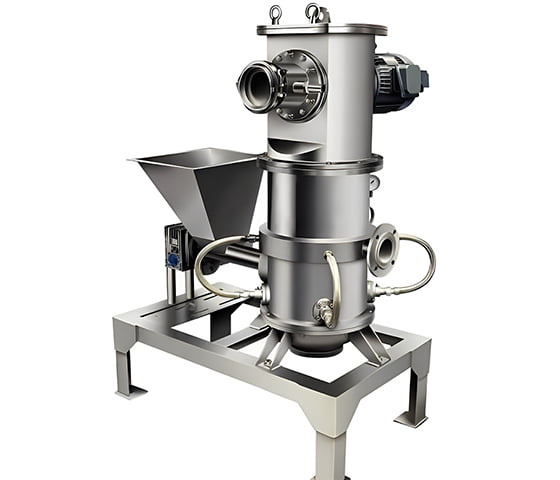
Fluidized bed Jet Mill
The fluidized bed jet mill is suitable for ultrafine size reduction of a wide range of dry, brittle materials, including hard and abrasive materials with a Mohs hardness of up to 10.
Fluidized bed jet mills are typically used in applications requiring fine micronization, especially when a narrow particle size distribution and high product purity are important.
D97<2μm
Achievable Fineness
±5%
PSD Consistency
1t+
Capacity Per hour
Principle
Precision Classification, Zero Contamination.
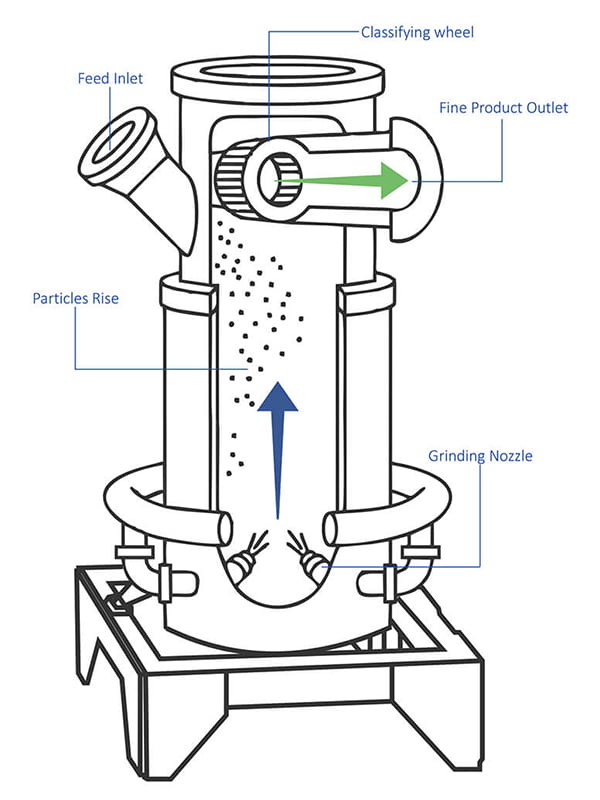
Fluidized bed Jet Mill working principle
Material Feeding
The feed material is introduced to the grinding chamber through a rotary valve or a screw feeder. The particles settle in the lower section of the chamber, creating a fluidized bed ready for processing.
Impact & Comminuition
Material is entrained by the high-velocity gas streams created by the nozzles, and size reduction occurs as a result of particle-to-particle collision in the gas stream and at the focal point of the nozzles.
Centrifugal Classification
The coarse and fine particles are separated due to the centrifugal force generated by the rotating classifier. The fine particles that meet the size requirements enter the cyclone separator and dust collector for collection.
Collection & Recovery
The qualified fines exit the mill and are transported to a cyclone separator for primary collection. The remaining ultra-fine dust is captured by a dust collector.
Features
Dynamic Particle Size Control
Narrower PSD
The integrated high-speed dynamic classifier ensures precise control over the cut point. This results in a highly uniform end product with a steep distribution curve and minimal deviations.
Contamination-Free
Since the high-energy impact happens in the center of the grinding chamber rather than against the walls, equipment erosion is significantly reduced. This makes it the ideal solution for processing high-purity materials.
High Automation
PLC-based systems track grinding pressure, classifier speed, and feed rate in real time. A closed-loop feedback maintains consistent product quality.
Specification
| Model | Chamber Ø (mm) | Capacity (kg/hr) | Air Consumption (m³/min) | Working Pressure (MPa) |
|---|---|---|---|---|
| LHC80 | 80 | 0.1 - 1 | 0.6 - 1.5 | 0.8 - 1.0 |
| LHC150 | 150 | 0.5 - 10 | 2.5 - 3.5 | 0.8 - 1.0 |
| LHC200 | 200 | 4 - 20 | 4.0 - 5.0 | 0.8 - 1.0 |
| LHC300 | 300 | 10 - 80 | 6.5 - 7.0 | 0.8 - 1.0 |
| LHC350 | 350 | 20 - 150 | 10.0 - 12.0 | 0.8 - 1.2 |
| LHC450 | 450 | 50 - 500 | 20.0 - 23.0 | 0.8 - 1.2 |
| LHC600 | 600 | 300 - 1500 | 35.0 - 40.0 | 0.8 - 1.2 |
* Capacity values are indicative and depend on material properties, target fineness, and operating pressure.
** The specific feed size depends on the chamber size.
General Parameters
- Achievable D97 < 2 - 20 μm
- Feed Particle Size (max) ≤ 3 mm
- Contact Material Stainless steel / Ceramic
- Surface Finish (Ra) ≤ 0.4 μm
- Gas Type Air / N₂ / Ar
- Chamber Temperature 10 - 20 °C
- Certifications CE / GMP / ATEX
Download Full Technical Datasheet
Get the complete specifications, and performance data in one document. PDF · ~2MB
Applications
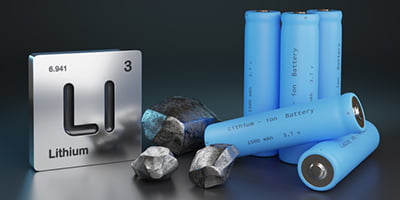
Cathode & Anode
Ultra-fine milling of LFP, NCM, NCA, and graphite under inert N₂ atmosphere to prevent oxidation, ensuring electrochemical performance and consistent D50 for electrode coating uniformity.
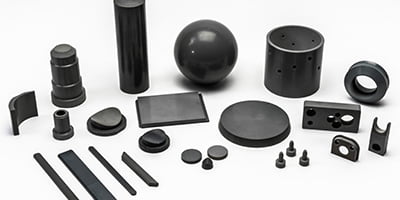
Advanced Ceramics
For materials with a Mohs hardness above 7, its particle-on-particle impact mechanism eliminates metal contamination from grinding media, preserving material purity.

Agrochemical & Pigments
The self-grinding action and absence of moving wear parts prevent metallic contamination, crucial for high-purity pigments and specialty chemicals.
Reactive Materials
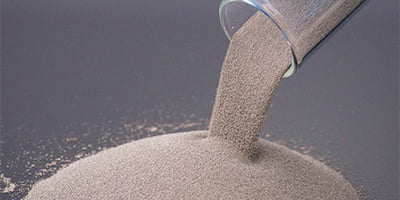
It can be safely operated with inert gas for reactive or explosive materials such as energetic chemicals, metal powders. The fully sealed system prevents oxygen ingress and dust leakage.
FAQ
Answers to the most common technical and commercial questions from procurement managers and process engineers evaluating fluidized bed jet mills.
Still have questions?
Our engineers are available for a 30-minute technical consultation.
Book a ConsultationIn which situation is a Fluidized Bed Jet Mill best used?
Can it be used in pharmaceutical manufacturing?
How is the final particle size controlled?
The final particle size is mainly controlled by:
- Classifier speed
- Grinding gas pressure
- Feeding rate
- Material characteristics
Is it suitable for continuous production?
Related Equipment
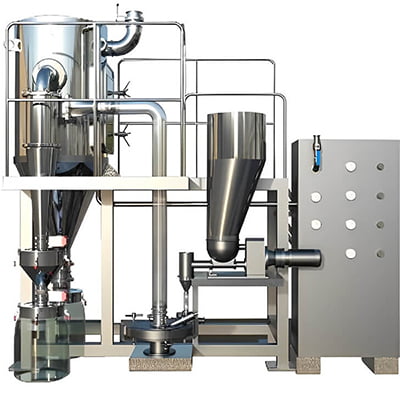
Spiral Jet Mill
A flat, disc-shaped grinding chamber with tangentially arranged nozzles creates a spiral gas vortex.
Learn More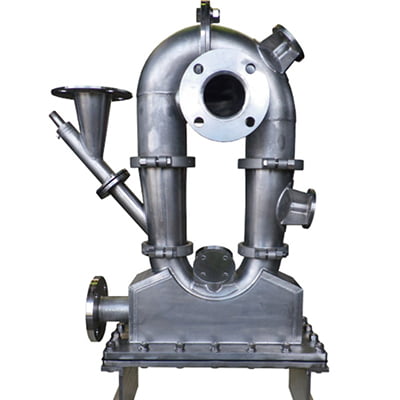
Loop Jet Mill
An oval or racetrack-shaped grinding loop where particles are accelerated and repeatedly collide along the loop path.
Learn More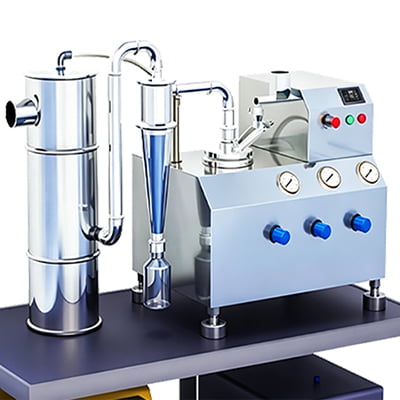
Laboratory Jet Mill
Ideal for early-stage R&D, formulation development, and small-batch feasibility studies.
Learn More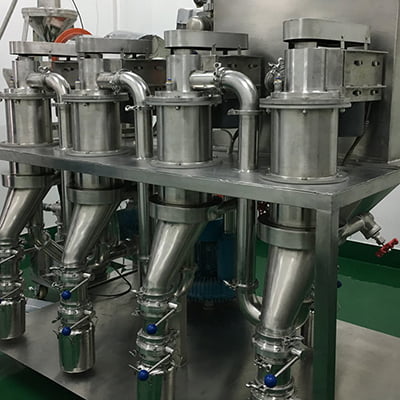
Air Classifier
Separates fine and coarse particles using controlled airflow; provides sharp cuts and precise particle size distribution.
Learn More