
Overview
Spiral Jet Mill
A spiral jet mill is also called a pancake jet mill. The spiral jet mill is suitable for the fine and ultrafine size reduction of materials up to a Mohs hardness of 9 that display brittle crystalline grinding characteristics. They are typically used in applications where a high ultrafine portion is required.
D97<2μm
Fineness Range
0°C+
Heat-Free Process
360°
Process Support
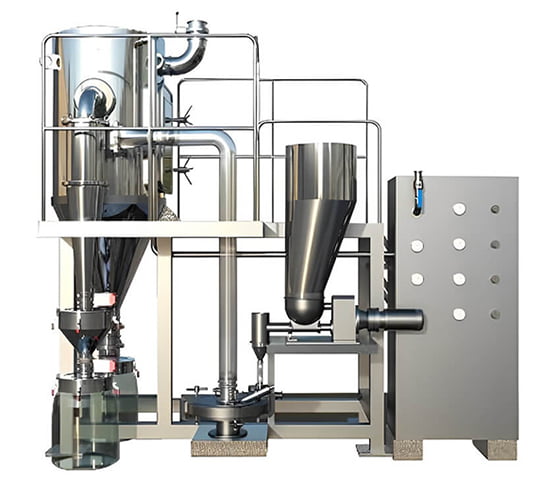
Principle
No Moving Parts, No Contamination.
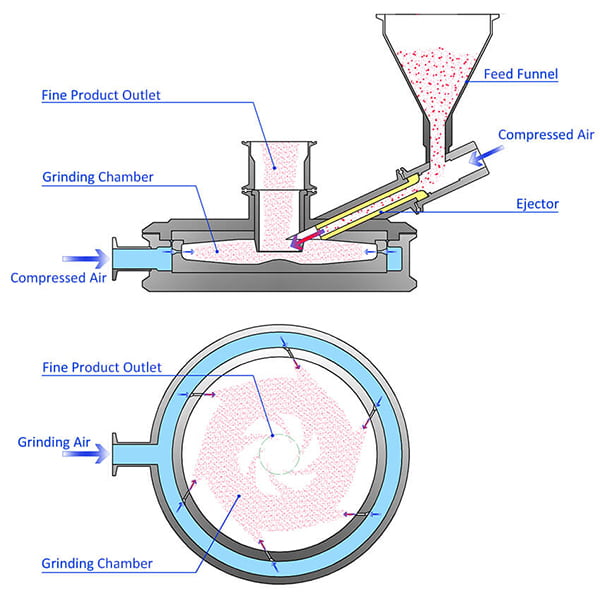
Spiral Jet Mill Diagram
Compressed Gas Injection
High-pressure compressed air or inert gas is injected tangentially through precisely angled nozzles arranged around the grinding chamber periphery, generating a supersonic spiral vortex.
Particle Acceleration & Collision
The raw material is introduced into the chamber via a venturi injector. Particles are instantly entrained and accelerated by the supersonic gas stream. Grinding occurs primarily through inter-particle collision.
Centrifugal Classification
This stage acts as an internal sorting mechanism governed by the equilibrium between the centrifugal force and the centripetal drag force. As particles become finer, their mass decreases until the drag force overcomes the centrifugal force.
Collection & Recovery
Once the particles pass the internal classification "cut point," they exit through the central discharge port along with the exhausted gas. The fine powder is then conveyed to a cyclone separator or a high-efficiency bag filter.
Features
Zero Contamination
No grinding media, no rotating mechanical parts inside the chamber. Particle-on-particle impact ensures product purity -- critical for API milling, food-grade, and battery cathode materials.
Cool Grinding
As the compressed gas expands through the nozzles, it creates a cooling effect (Joule-Thomson effect) that counteracts any heat generated during impact. This makes it the ideal solution for processing heat-sensitive material.
Precise Particle Size Control
Equipped with an integrated static classification mechanism, the mill ensures a narrow particle size distribution. Achieve D50 of 1-10 μm and D97 below 20 μm with consistent batch-to-batch reproducibility.
Material Testing Available Before Purchase
Submit your material sample for a no-obligation lab trial.
Specification
| Model | Chamber Ø (mm) | Capacity (kg/hr) | Air Consumption (m³/min) | Working Pressure (MPa) |
|---|---|---|---|---|
| AS50 | 50 | 0.05 - 0.5 | 0.6 - 0.9 | 0.6 - 1.0 |
| AS100 | 100 | 0.5 - 1 | 1.6 - 2.0 | 0.6 - 1.0 |
| AS150 | 150 | 2 - 10 | 2.5 - 3.5 | 0.6 - 1.0 |
| AS200 | 200 | 5 - 20 | 4.0 - 5.0 | 0.8 - 1.0 |
| AS300 | 300 | 10 - 80 | 6.5 - 7.0 | 0.8 - 1.0 |
| AS350 | 350 | 20 - 180 | 7.0 - 12.0 | 0.8 - 1.2 |
| AS450 | 450 | 40 - 400 | 10.0 - 12.0 | 0.8 - 1.2 |
| AS650 | 650 | 50 - 600 | 20.0 - 27.0 | 0.8 - 1.2 |
| AS1000 | 1000 | 500 - 2000 | 40.0 - 50.0 | 0.8 - 1.2 |
* Capacity values are indicative and depend on material properties, target fineness, and operating pressure.
** The specific feed size depends on the chamber size.
General Parameters
- Achievable D97 < 2 - 20 μm
- Feed Particle Size (max) ≤ 3 mm
- Contact Material Stainless steel / Ceramic
- Surface Finish (Ra) ≤ 0.4 μm
- Gas Type Air / N₂ / Ar
- Chamber Temperature 10 - 20 °C
- Certifications CE / GMP / ATEX
Download Full Technical Datasheet
Get the complete specifications, and performance data in one document. PDF · ~2MB
Applications

API & Excipient
Ideal for micronizing active pharmaceutical ingredients (APIs) and excipients to achieve controlled particle size distributions with no contamination.
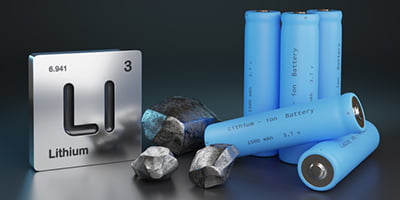
Cathode & Anode
Ultra-fine milling of LFP, NCM, NCA, and graphite under inert N₂ atmosphere to prevent oxidation, ensuring electrochemical performance and consistent D50 for electrode coating uniformity.
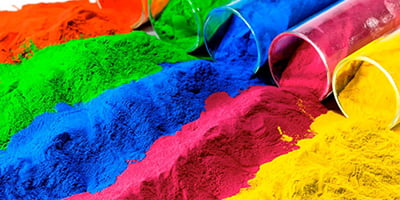
Fine chemical and pigment
The absence of moving parts and mechanical heat generation ensures that heat-sensitive pigments and reactive chemical intermediates remain chemically stable during processing.

Nutraceuticals
Gentle, heat-free micronization of vitamins, herbal extracts, spices, and functional food ingredients -- preserving bioactivity and flavor compounds while achieving ultra-fine particle sizes.
FAQ
Answers to the most common technical and commercial questions from procurement managers and process engineers evaluating spiral jet mills.
Still have questions?
Our engineers are available for a 30-minute technical consultation.
Book a ConsultationWhat particle size can a spiral jet mill achieve?
How is the spiral jet mill cleaned between product changeovers?
Spiral jet mills are relatively easy to clean due to their simple geometry:
- The grinding chamber can often be opened and accessed without tools.
- Cleaning can be done by vacuuming, blowing with compressed air, or washing.
- Quick disassembly is possible, typically within 5–10 minutes.
How do I control the final particle size?
Key parameters:
- Grinding pressure – higher → finer, but up to a limit.
- Feed rate – slower feed generally provides finer product.
For spiral jet mills without a separate classifier, the design of the outlet vortex circle determines the cut point.
What are the limitations of a spiral jet mill?
- Particle size distribution is less steep than fluidized bed mills
- Not ideal for sticky, ductile, or very soft materials
- Higher wear when processing very hard or abrasive materials
Related Equipment
You May Also Need
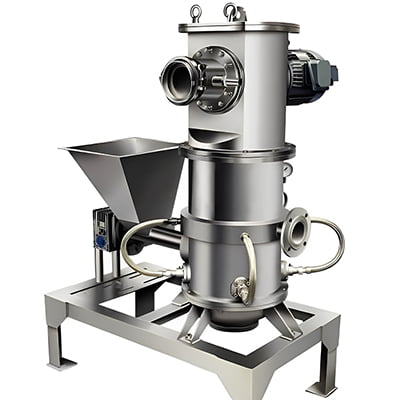
Fluidized Bed Jet Mill
Multiple horizontal nozzles create a fluidized bed of particles that collide at the convergence zone.
Learn More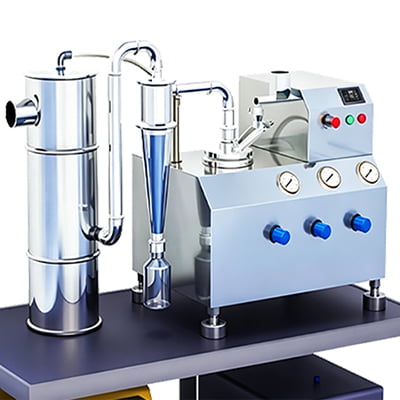
Laboratory Jet Mill
Ideal for early-stage R&D, formulation development, and small-batch feasibility studies.
Learn More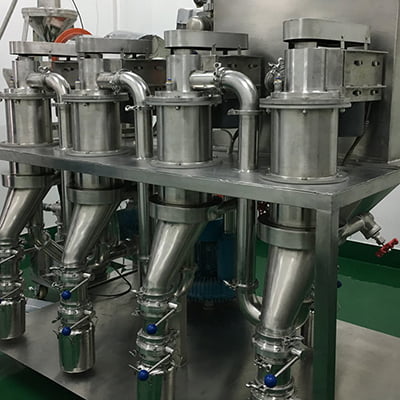
Air Classifier
Separates fine and coarse particles using controlled airflow; provides sharp cuts and precise particle size distribution.
Learn More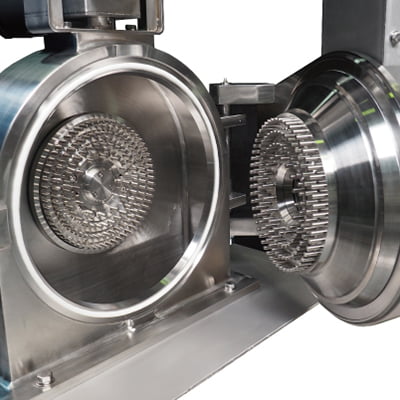
Pin Mill
Utilizes high-speed pin discs for fine grinding, providing uniform particle size distribution for dry, friable materials.
Learn More