
Overview
Pin Mill
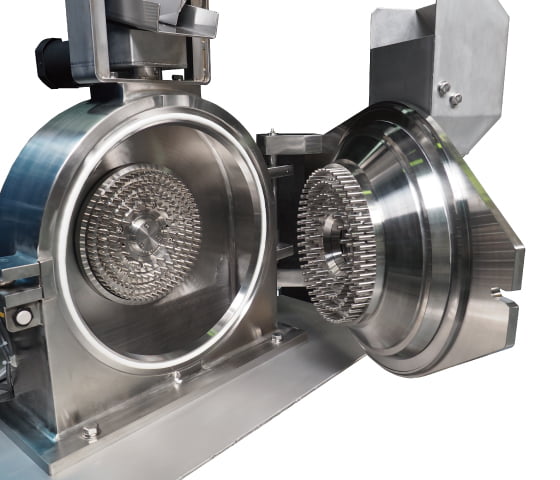
Unlike many impact mills that rely on screens to control particle size, a pin mill uses a high-speed rotor with numerous pins that interact with stationary pins, creating intense shear and impact zones. This design allows the pin mill to produce powders with the desired particle size without the need for screens.
D50≥10μm
Fineness Range
Mohs≤3.5
Suitable for Material
1000kg/h
Max Throughput
Principle
How does a Pin Mill work?
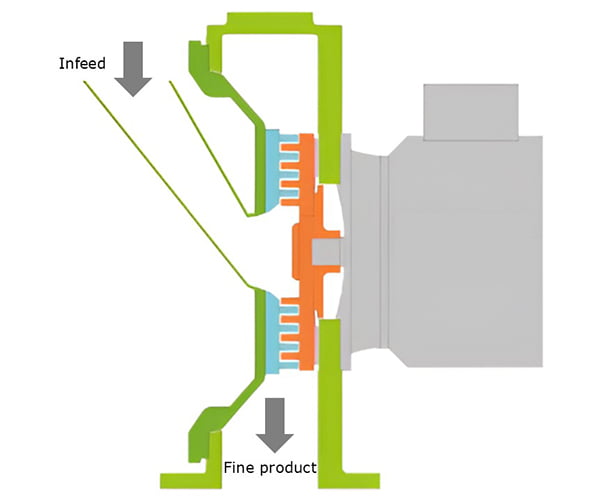
Pin mill diagram
Material Feeding
The raw material is initially loaded into the inlet hopper located at the top of the pin mill. A metering feeder delivers the material at a controlled rate into the grinding chamber of the mill.
Impact Size Reduction
As the material enters the center of these discs, it is subjected to intense impact, shear, and collision forces between the fixed pins and the rapidly moving pins on the rotor. This impact action shatters the particles into finer sizes.
Discharge
Once the material is sufficiently milled, it is discharged smoothly from the bottom of the unit. The final particle size can be precisely adjusted by varying the rotor speed.
Features
Engineered for Your Particle Size
Screenless Design
The screenless operation eliminates the root causes of contamination such as screen wear, clogging, and the shedding of screen material. As a result, it is particularly well suited for high-purity material processing where even trace contamination is unacceptable.
Special Atmosphere Operation
The equipment is designed to operate reliably under low-temperature conditions and in an inert gas environment. With a pressure-resistant construction rated at 10 bar, it can work safely under high-pressure protective gases like nitrogen.
Precise Particle Size Control
The rotor speed can be continuously adjusted via a VFD, allowing flexible and precise control over the final particle size. This enables quick switching between different product specifications without mechanical modifications.
Material Testing Available Before Purchase
Submit your material sample for a no-obligation lab trial.
Specification
PM Series — Data Sheet
| Model | Rated power (kW) | Grinding speed (rpm) | Capacity (kg/h) |
|---|---|---|---|
| PM100 | 2.2 | 1,000-20,000 | 0.5 - 10 |
| PM150 | 3.7 | 1,000-18,000 | 0.5 - 100 |
| PM260 | 4.5 | 1,000-16,000 | 20 - 500 |
| PM350 | 11 | 1,000-12,000 | 30 - 1,000 |
* Capacity values are indicative and depend on material properties, target fineness.
General Parameters
- Achievable D50 < 10 - 100 μm
- Feed Particle Size (max) ≤ 2 mm
- Contact Material Stainless steel / Ceramic
- Grinding speeds Max. 200 m/s
- Hardness of material 1 - 3.5 Mohs
Download Full Technical Datasheet
Get the complete specifications, and performance data in one document. PDF · ~2MB
Applications
Industry Applications
Lorem ipsum dolor sit amet, consectetur adipiscing elit, sed do eiusmod tempor incididunt ut labore et dolore magna aliqua. Ut enim ad minim veniam, quis nostrud exercitation ullamco laboris.

Spices & Grain
Inverter control allows operators to fine-tune the rotation speed to match the precise particle size required for different food products.
Special Chemical
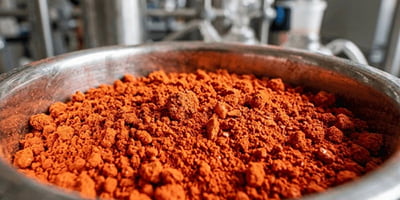
Pin mills integrate seamlessly with inert gas protection, enabling the safe milling of oxidation-prone chemicals or hazardous materials prone to dust explosions.
Resins
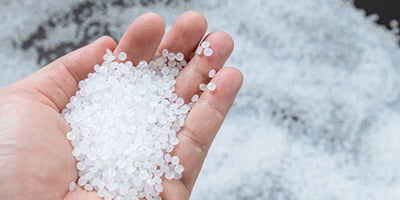
To process tough resins, materials are pre-cooled with liquid nitrogen below their glass transition point. The intense impact shatters these embrittled resins instantly.

Cosmetic Ingredients
The mill is also employed in processing materials for cosmetics and traditional herbal medicines, where fine and contamination-free grinding is critical.
FAQ
Answers to the most common technical and commercial questions from procurement managers and process engineers evaluating pin mills.
Still have questions?
Our engineers are available for a 30-minute technical consultation.
Book a ConsultationWhy does a pin mill not use a screen?
The pin mill’s screenless design is rooted in a shift from mechanical restriction to dynamic control.
- Shearing vs. Compressing – Instead of forcing material through a screen, the pin mill uses high-speed impacts and shearing forces to break down particles.
- Anti-Clogging – There's no screen for sticky, oily, or wet stuff to get caught on, so things keep moving smoothly.
How to adjust the particle size of the finished product?
Fineness is controlled by these key parameters:
- Rotor Speed – Higher speed → Finer product
- Feed Rate – Lower rate → More impacts per particle → Finer output
What materials is a pin mill suitable for grinding?
How is the noise level of a pin mill?
Can a pin mill be cleaned for use with different materials?
Yes, but thorough cleaning is required.
To clean it, just run the machine empty and blow compressed air through it, or take the stator disc apart and wash it by hand.
Related Equipment
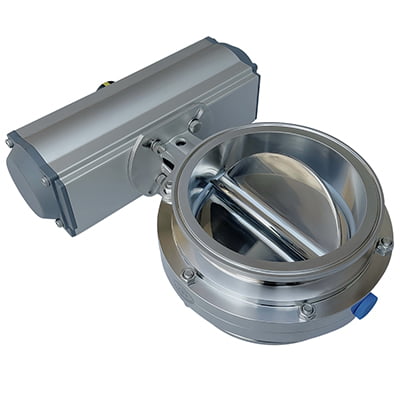
Rotary Feeder Valve
Provides controlled and metered feeding of bulk solids, helping to prevent excessive material flow.
Learn More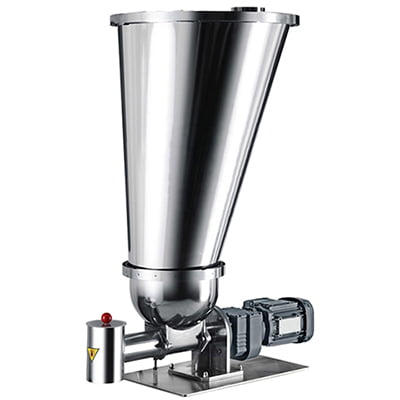
Volumetric Feeder
Delivers consistent material flow based on volume measurement, suitable for stable and simple dosing applications.
Learn More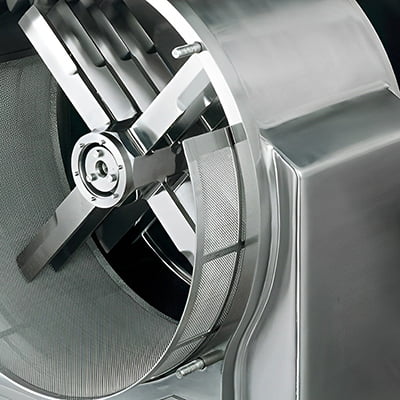
Hammer Mill
Reduces material size by high-speed rotating hammers, suitable for medium grinding of various brittle materials.
Learn More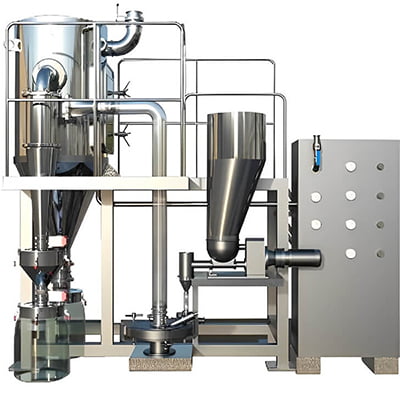
Jet Mill
Uses compressed air to achieve ultra-fine grinding without heat, ideal for heat-sensitive and high-purity materials.
Learn More