
Overview
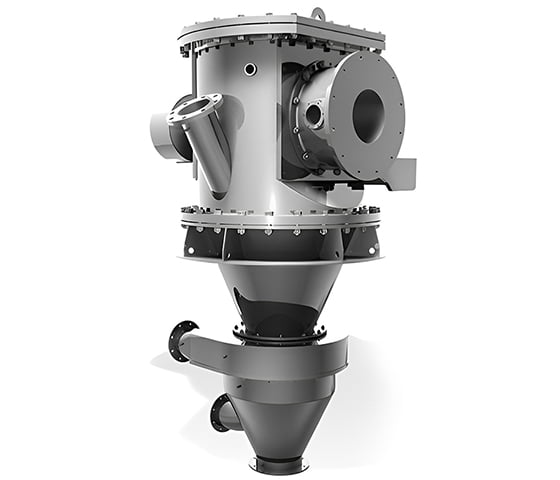
Air Classifier
The realization of powdered material functionality often requires the particle size to meet certain conditions. For example, Zirconia powder for ceramic glaze requires an average particle diameter of 1-2 microns. Metal powder for 3d printing requires good sphericity, fine particle size and narrow particle size distribution. It is necessary to classify the powder particles to meet for specific applications.
Classification is the operation of separating the powder into two groups of large and small particles. In an air classifier, the powder is subjected to air resistance and centrifugal force, thus accomplishing the operation of classifying ultra-fine powders.
D97<2μm
Cut Point Range
2t/h
Throughput
90%
Efficiency
Principle
How does an Air Classifier Work?
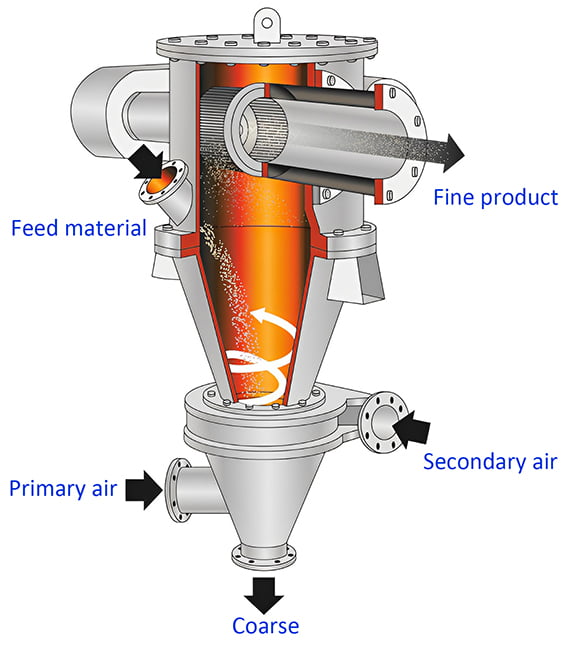
Schematic diagram of an air classifier
Material Feeding
The material enters through the lower feed inlet and is carried upward by a high-speed rising airflow generated by the fan, moving into the classifying zone.
Primary Separation
Inside the classifying zone, a dynamic classifying wheel creates strong centrifugal force. Fine particles meeting the size requirement pass through the gaps between the classifier wheel and are collected in a cyclone separator or dust collector.
Secondary Rinsing
As the dropped particles fall, they reach the secondary air inlet. There, the powerful washing action of the secondary air separates the remaining fine particles from the coarse ones.
Coarse Material Rejection
The fully separated and rejected coarse material continues down under gravity and is safely discharged at the bottom of the classifier.
Features
Micron-Level Precision
Achieves ultra-fine classification at the micron level, making it highly suitable for diverse particle morphologies.
Flexible Cut-Point Range
Offers a wide particle size cut-point adjustment range, efficiently handling sizes anywhere from 1 to 100 microns.
Dynamic Control
Allows for precise, real-time control of the cut-point during operation simply by adjusting the rotor speed and airflow rate.
High Efficiency
Exceptional performance with a classification efficiency reaching up to 90%.
Multi-Fraction Capability
Supports multi-stage setups where multiple classifiers can be used in series to separate several particle size ranges.
Automated Operation
Equipped with PLC control for real-time monitoring of system operation, ensuring high stability and minimal manual intervention.
Specification
ATP Series -- Data Sheet
| Model | Rated power (kW) | Cut point d97 (micron) | Efficiency (%) | Feed Rate (kg/h) |
|---|---|---|---|---|
| ATP01 | 7 - 11 | 2 - 45 | 60 - 90 | 10 - 100 |
| ATP02 | 15 - 19 | 2 - 45 | 60 - 90 | 20 - 200 |
| ATP03 | 21 - 28 | 2 - 45 | 60 - 90 | 50 - 500 |
| ATP04 | 23 - 30 | 3 - 45 | 60 - 90 | 100 - 1500 |
| ATP05 | 52 - 60 | 3 - 45 | 60 - 90 | 200 - 2000 |
* Capacity values are indicative and depend on material properties, target fineness range.
General Parameters
- Classification Cut Point (D97) 2 - 45 μm
- Recovery Rate up to 99%
- Contact Material Steel / Ceramic
- Rotor Speed 1,000 - 12,000 rpm
- Air Volume Flow 300 - 6,000 m³/h
Download Full Technical Datasheet
Get the complete specifications, and performance data in one document. PDF · ~2MB
Applications
Precise Classification for Ultrafine Powders
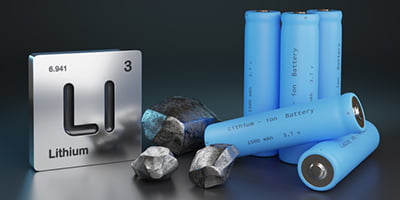
Cathode Materials
Precision classification of LFP, NCM, and LCO to achieve narrow particle size distribution PSD for high energy density.
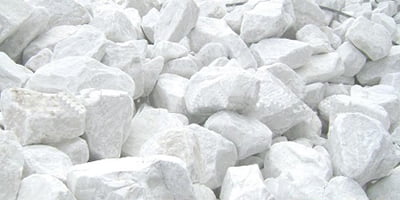
Ultra-Fine Minerals
High-efficiency separation of ultra-fine industrial minerals and abrasives, ensuring sharp top-size cuts down to the sub-micron range.
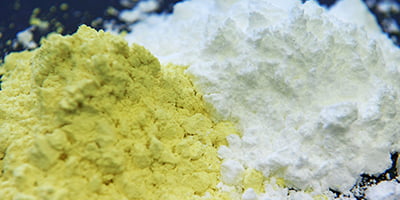
Dyes & Catalysts
Primarily for fine classification, narrow particle size control, and removal of coarse particles or fines.
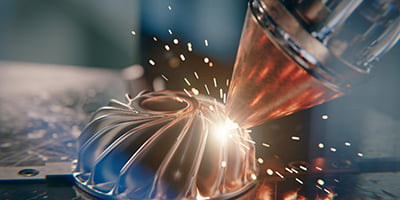
Metal powder
Tailoring the particle size distribution of spherical metal powders for high-quality 3D printing.
FAQ
Answers to the most common technical and commercial questions from procurement managers and process engineers evaluating air classifiers.
Still have questions?
Our engineers are available for a 30-minute technical consultation.
Book a ConsultationWhat particle size can an air classifier achieve?
Can air classifiers handle abrasive materials?
How does an air classifier compare to a cyclone?
Can the classifier be used in a closed‑loop system?
Yes. For example, in a ball mill + air classifier closed system.
- The mill discharges to the classifier.
- Fines are collected as product; the coarse fraction returns to the mill for further grinding.
Related Equipment
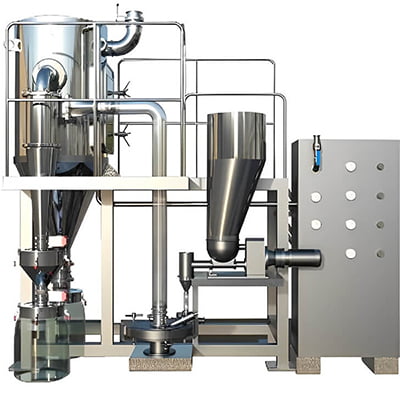
Jet Mill
Uses compressed air to achieve ultra-fine grinding without heat, ideal for heat-sensitive and high-purity materials.
Learn More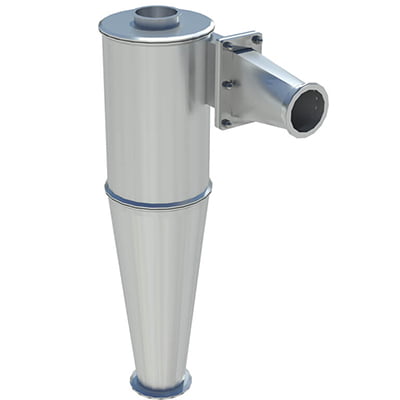
Cyclone Separator
Separates particles from air streams using centrifugal force, enabling efficient dust recovery and gas-solid separation.
Learn More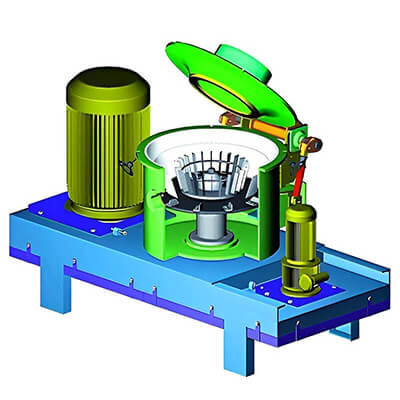
Air Classifier Mill
Combines grinding and classification in one unit; internal classifier instantly extracts fines for consistent, efficient output.
Learn More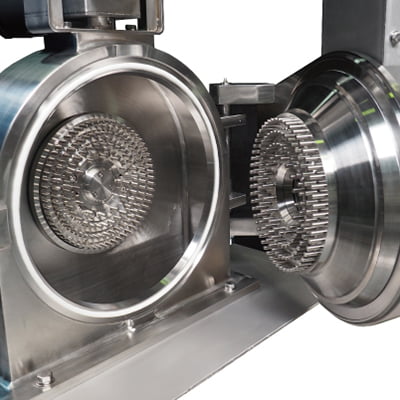
Pin Mill
Utilizes high-speed pin discs for fine grinding, providing uniform particle size distribution for dry, friable materials.
Learn More