
Jet Mill Working Principle
This article aims to describe the working principle of a jet mill. A jet mill, also called fluid energy mill, is used for solid material micronization.
How Does a Jet Mill Work?
Micronization is a term used to describe size reduction where the resulting particle-size distribution is less than 10 microns. Jet mills are used for micronizing of solids of chemicals, pharmaceuticals, pigments, minerals and others like heat sensitive, corrosive and abrasive materials.
In many cases, the micronization process is often considered as a black box that produces fine powder and coarse particles enter. Jet mills operate in compressed air, gas or high pressure superheated steam. Jet mills have no moving parts, thereby eliminating contamination due to contact with external grinding media. It is also an ideal process to grind heat-sensitive and waxy material because no attritional heat is generated.
Core Operating Mechanism
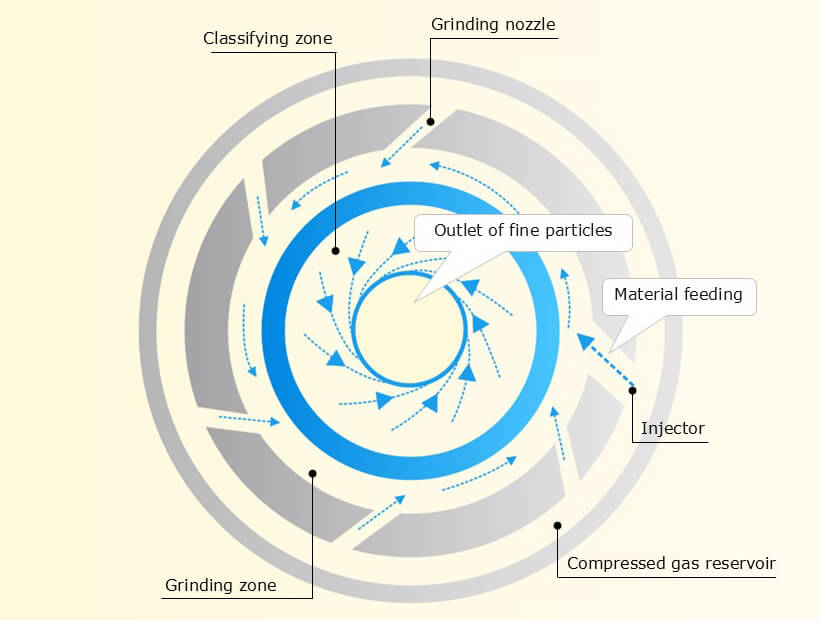
Jet mill works on fluid energy. Consider a pancake spiral jet mill as an example. Micronizing and classification take place in a shallow, cylindrical chamber. High pressure air or steam is injected in this chamber through the specially designed nozzles placed at regular distance, on the peripheral wall. The axis of each jet is tangential to the circumference of a smaller, imaginary, concentric circle.
-
01
Feeding & Acceleration
During operation, the material is fed into this vortex along an engineered tangent circle and accelerates. Feed particle size is critical, restricted by the size of the feed injector. For mills of 200-300 mm, the feed size can be a maximum of 1.5 mm. For smaller-size mills, the feed size is correspondingly finer.
-
02
Particle-to-Particle Collision
Strong velocity gradients near the jet cause the suspended particles of the material to collide with each other and reduce themselves by attrition and collision. Size reduction is the result of the high-velocity collisions between particles of the process material itself. No grinding media is involved.
-
03
Centrifugal Classification
Heavier oversized particles are held in the grinding chamber by centrifugal force, until micronized to a desired size.
-
04
Fine Particle Discharge
The jet fluid exits through an outlet at the center of the chamber either from top and draws the micronized the particles with it to the cyclone collection system.
There are several factors, both operational and physical, which affect the fineness of the end product, such as feed rate, nozzle size, grinding pressure, nozzle angle, airflow rate, feed particle size, chamber diameter and width, and product outlet diameter. In general, the geometric dimensions of a jet mill are fixed during the design and manufacturing stages. Therefore, once the mill is in operation, the desired particle-size distribution is typically controlled by adjusting the feed rate and grinding pressure.
Actually the spiral jet milling process is not governed only by the jet mill itself. It is a process involving different machines and components which need to be properly integrated and controlled. These accessories include a source of fluid energy, a feeder, a cyclone separator, a dust collector etc.
Jet Mill Types
While the spiral jet mill is the most common configuration, several design variants exist to address different process requirements:
Spiral Jet Mill
A flat, disc-shaped grinding chamber with tangentially arranged nozzles creates a spiral gas vortex —no external classifier required.
Fluidized Bed Jet Mill
External dynamic classifier wheel provides precise, adjustable cut-point. Ideal for high-throughput and narrow PSD applications.
Loop Jet Mill
An oval or racetrack-shaped grinding loop where particles are accelerated and repeatedly collide along the loop path.
Jet Milling Examples
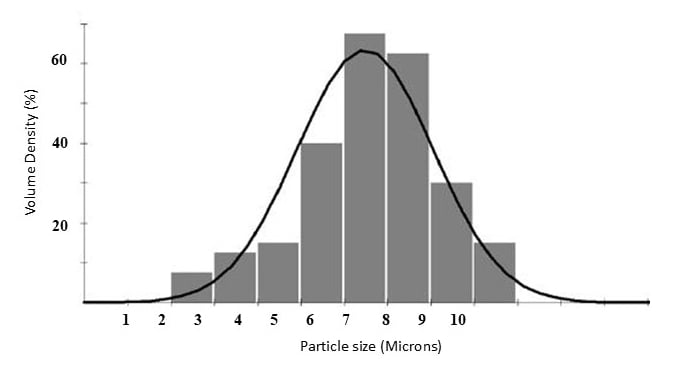
The demand for pharmaceutical ingredients including finely ground active substances and excipients is growing. Injectable drugs and dry powder inhalants require particle-size distributions in the range of 2-20 microns with a steep distribution curve and a minimum of fine and over-sized particles. Jet milling is a highly effective technology for reducing particle size of inhalation and other drug products where the size of the particle is relevant to the effective delivery.
Advantages of Jet Mills
Jet mills offer a distinct set of technical and operational advantages that make them the preferred choice for demanding micronization applications. Understanding these advantages is essential for procurement and engineering teams evaluating milling technology for high-value products.
Ultra-Fine Particle Size
Jet mills routinely achieve D50 values of 1-10 μm and D97 values below 20 μm — particle size ranges that are extremely difficult or impossible to achieve reliably with mechanical mills. For inhalation APIs, sub-2 μm D50 is achievable.
No Thermal Degradation
The expanding jet gas also has a cooling effect. This makes jet milling particularly suitable for heat-sensitive materials such as pharmaceuticals, explosives, resins, and certain food ingredients that could degrade or melt under traditional grinding conditions.
Zero Contamination
There is no contact with balls, hammers, or other wear parts that could introduce foreign materials. Additionally, the mill can be constructed with ceramic or polymer liners to further prevent metal contamination. As a result, the final product retains its original chemical purity.
Low Maintenance & High Reliability
No grinding media, screens are involved, which means there are fewer components subject to wear and tear. Maintenance typically involves only routine inspection. The absence of mechanical drives or bearings in the grinding zone reduces downtime and repair costs.
Disadvantages of Jet Mills
A rigorous procurement and engineering evaluation requires an honest assessment of limitations. Understanding these constraints enables informed technology selection and proper system design to mitigate risks.
High Energy Consumption
Operational CostJet mills rely on compressed air or inert gases moving at supersonic speeds to achieve particle-to-particle collision. Generating this continuous high-pressure airflow requires massive electrical power for the air compressors.
Limited Feed Particle Size
Pre-processing NeededJet mills cannot accept large, coarse raw materials. The typical maximum feed size is around 2 mm. This means factories must install a pre-grinding system before feeding materials into the jet mill.
Incompatibility with Sticky and Elastic Materials
Material LimitationsJet mills are highly dependent on the brittle fracture of particles through high-velocity impact. Consequently, materials that exhibit stickiness, high moisture content, or elasticity are not suitable for jet milling.
Typical Material Processed
Our jet mill systems are engineered to handle a broad spectrum of materials across demanding industries.
Agrochemicals
- Deltamethrin
- Carbendazim
- Carbaryl
- Germicide
- Herbicide
- Fungicide
Chemicals
- Adipic acid
- Barium titanate
- Calcium chloride
- Chromium oxide
- Catalyst
Ceramics
- Alumina
- Silicon carbide
- Zirconia
- Silicon nitride
- Barium titanate
Minerals
- Bauxite
- Gypsum
- Graphite
- Mica
- Talc
- Tantalum ore
Pigment
- Carbon black
- Fluorescent pigment
- Titanium dioxide
- Iron Oxides
- Azo pigments
Pharmaceuticals
- Amino Acid
- Antibiotics
- Aspirin
- Guanylate
- Furosemide
- Penicillin