
Overview
Rotary Atomizer Spray Dryer
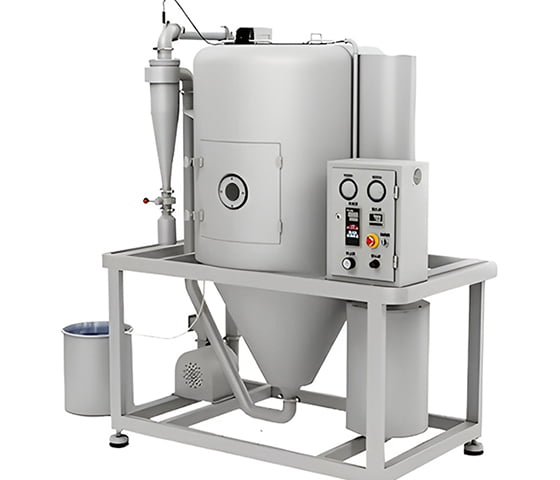
A Rotary Atomizer Spray Dryer, also known as a Centrifugal Spray Dryer, is the most commonly used type of spray drying system. It is mainly used to rapidly convert liquids, such as solutions, suspensions, and slurries, into dry powders or granules.
The system uses a high-speed rotary atomizer to disperse the liquid into fine droplets by centrifugal force. The droplets are then brought into contact with hot air, where moisture evaporates instantly, resulting in a dry, free-flowing powder.
20-300μm
Particle Size Range
1-10s
Fast Drying
10+t/h
Evaporation Capacity
Principle
Step-by-Step Breakdown of a Rotary Atomizer Spray Dryer
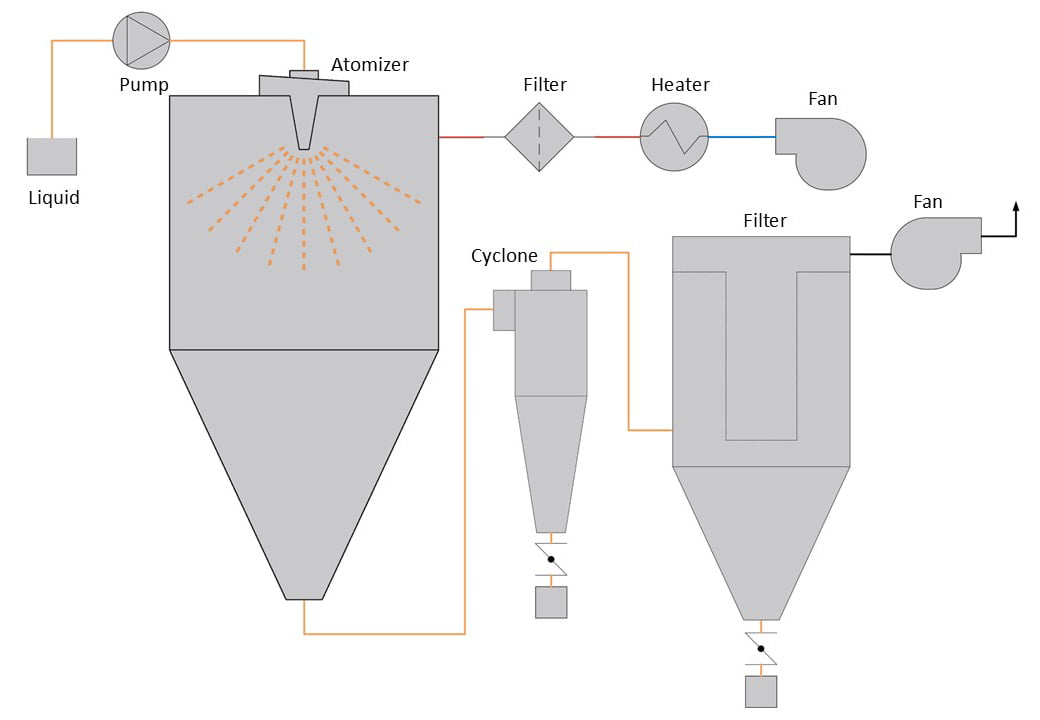
Schematic Diagram of Rotary Atomizer Spray Drying
Liquid Feed
The liquid material is pumped from the feed tank through a filter and flow control system to the top of the drying chamber, where the rotary atomizer is located.
Centrifugal Atomization
The liquid enters the center of a high-speed rotating disk or wheel. The atomizer spins at very high speed, generating strong centrifugal force that breaks the liquid into a large number of fine droplets.
Hot Air Introduction
At the same time, ambient air is drawn in, filtered, and heated to the required inlet temperature. The hot air is then directed into the drying chamber, usually in a co‑current or mixed flow around the atomizer cloud.
Droplet Drying
The fine droplets come into immediate contact with the hot air. Moisture is vaporized almost instantly, while the droplet temperature remains relatively low due to the evaporative cooling effect.
Powder Formation
After moisture removal, the droplets are transformed into solid particles, forming dry powder or granules during their fall through the drying chamber.
Separation and Collection
The dried particles are collected at the bottom of the chamber or separated from the exhaust air using a cyclone separator and bag filter.
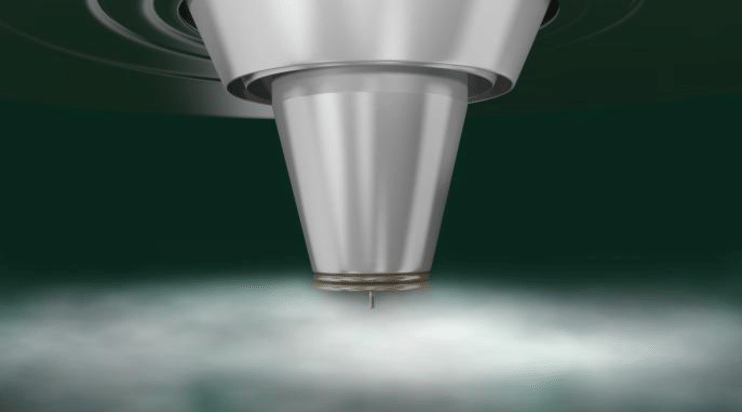
Centrifugal Atomizer
High-Speed Drive Motor
CoreCombined with a variable frequency drive, the drive motor serves as the power source of the centrifugal atomizer. Frequency inverter enables stepless speed control from 10,000 to 24,000 RPM, adapting to diverse feed viscosities and target particle sizes.
Atomizing Disk / Wheel
KeyThe atomizing disk is responsible for converting the liquid feed into fine droplets. The typical disk diameter ranges from Ø50 mm to Ø300 mm. The peripheral speed is set to 90-180 m/s to achieve a target D50 of 20-300 μm.
Central Feed Pipe & Distributor
FeedThe distributor ensures an even and continuous flow of liquid across the rotating disk, resulting in stable atomization and consistent powder quality.
Features
Controllable Droplet Size
By adjusting the rotational speed of the atomizing disk and the feed rate, the final product particle size can be precisely controlled (D50 typically in the range of 20-300 μm).
Wide Capacity Range
A single unit can handle feed rates ranging from a few hundred grams per hour at laboratory scale to tons per hour at industrial scale, making it suitable for lab trials, pilot studies, and full-scale manufacturing.
Strong Feed Adaptability
Unlike pressure nozzles, a rotary atomizer is less prone to clogging and can handle liquids containing particles, fibers, or relatively high viscosity.
Specification
LPG Series Data Sheet
| Parameter | 5 | 25 | 50 | 100 | 150 | 200+ |
|---|---|---|---|---|---|---|
| Inlet Temp. | 140-350°C adjustable | |||||
| Outlet Temp. | 80-90°C | |||||
| Max. Evap. Capacity | 5 kg/h | 25 kg/h | 50 kg/h | 100 kg/h | 150 kg/h | 200+ kg/h |
| Atomizer Drive | Pneumatic Drive | Motor Drive | ||||
| Atomizer Speed | 10,000-25,000 rpm | |||||
| Atomizer Disk Size | Ø50 mm | Ø100 mm | Ø120 mm | Ø140 mm | Ø150 mm | Ø180-340 mm |
| Heat Source | Electric / Steam | Electric / Steam / Oil / Gas | ||||
| Dry Powder Recovery Rate | ≥95% | |||||
All specifications subject to change. Custom configurations available for models 200+.
Download Full Technical Datasheet
Get the complete specifications, and performance data in one document. PDF · ~2MB
Applications
Typical Drying Applications Across Multiple Industries
Pharmaceutical
- Antibiotics
- Vitamin C
- Herbal Extracts
- Ceftriaxone Sodium
- Amoxicillin-clavulanate Potassium
Food & Additives
- Whole Milk Powder
- Whey Protein
- Coffee Extract
- Fruit Juice Powder
- Starch
Fine Chemicals
- Disperse Dyes
- Organic Pigments
- Surfactants
- Silica & Fumed Silica
- Organic Intermediates
Advanced Materials
- Lithium Iron Phosphate (LFP)
- NCM / NCA Cathode Materials
- Alumina Ceramics
- Battery Precursors
- Silicon Carbide
FAQ
Answers to the most common technical and commercial questions from procurement managers and process engineers evaluating rotary atomizer spray dryers.
Still have questions?
Our engineers are available for a 30-minute technical consultation.
Book a ConsultationHow can I control the particle size of the final product?
The main factors include:
- Rotational speed – The higher the speed, the finer the droplets.
- Feed viscosity & feed rate – Higher viscosity or faster feed rate tends to produce larger droplets.
- Atomizer disk structure – Different blade shapes (flat disk, vaned disk, grooved wheel) affect how droplets break up.
What are the common problems of a rotary atomizer spray dryer in operartion?
The typical problems include:
- Vibration / noise – May be caused by improper cleaning or bearing damage; requires shutdown for inspection and cleaning.
- Wall sticking – Caused by improper feed rate/viscosity; can be remedied by adjusting feed rate and inlet/outlet temperature.
- Low collection efficiency – Check whether the cyclone separator or bag filter is clogged.
- Product contamination – Replace filters regularly and clean the system thoroughly.
What maintenance does the rotary atomizer require?
Can the system support automatic operation?
Is the system easy to clean?
The system can be configured with different cleaning options:
- Manual Cleaning – Key components are designed for quick disassembly to facilitate cleaning and maintenance.
- CIP system – Automated internal cleaning without disassembly.
Related Equipment
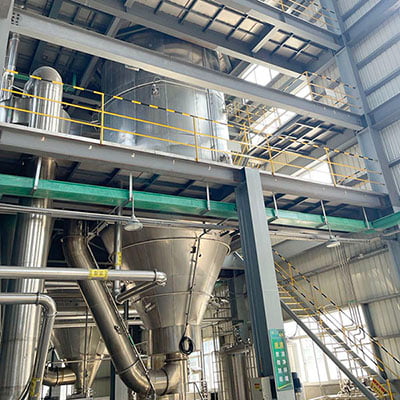
Pressure Nozzle Spray Dryer
High-pressure pump forces feed through a single-fluid nozzle. It produces coarser, denser particles.
Learn More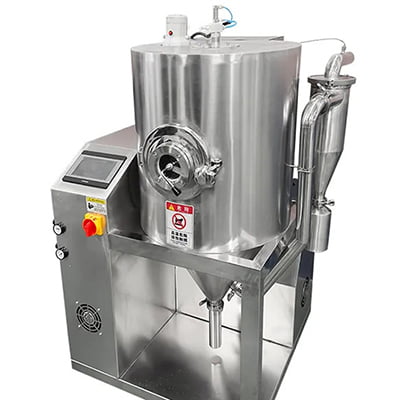
Two Fluid Nozzle Spray Dryer
Uses compressed gas and liquid feed to produce fine, uniform droplets for efficient spray drying.
Learn More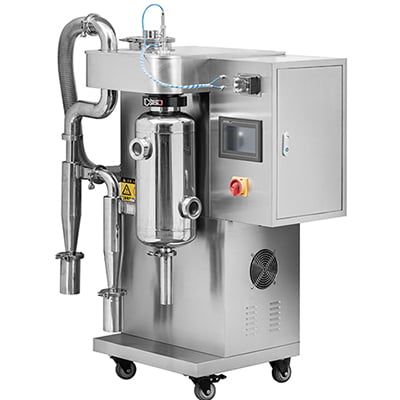
Lab Spray Dryer
A compact spray dryer designed for research, formulation development, and small-scale production.
Learn More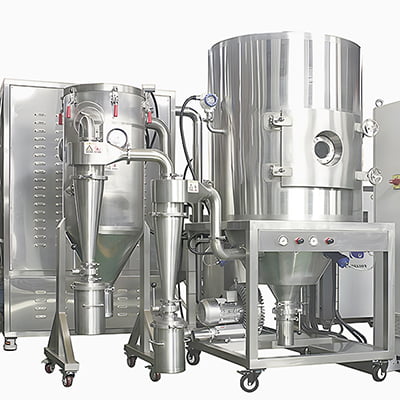
Pilot Spray Dryer
Ideal for process optimization, scale-up studies, and pilot-scale production before commercial manufacturing.
Learn More