
Overview
Pressure Spray Dryer
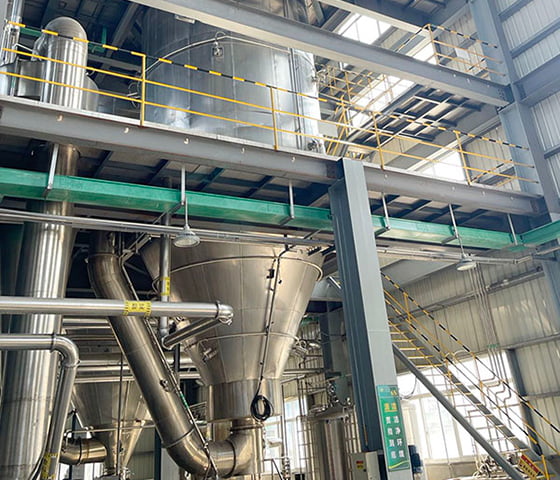
A Pressure Spray Dryer uses a high-pressure pump to force liquid feed through a small nozzle, creating fine droplets that quickly contact hot air in the drying chamber.
This system has a simple structure, relatively low energy consumption, and is suitable for medium to large-scale production.
50-350μm
Particle Size Range
2-10MPa
Pump Pressure
<5%
Final Moisture
Principle
Designed for optimal particle uniformity and thermal efficiency.
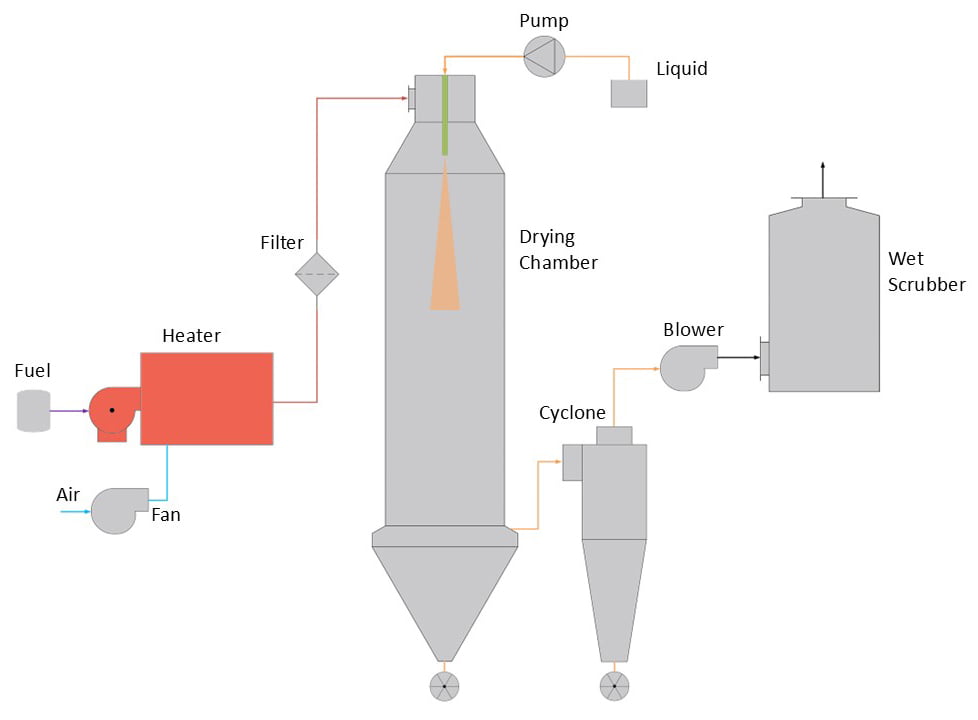
Schematic Diagram of Pressure Spray Drying
Feed Preparation
The liquid feed (solution, slurry, or emulsion) is prepared by filtering and adjusting properties such as concentration and viscosity to ensure stable atomization.
High-Pressure Pumping
The high-pressure pump pressurizes the liquid feed to typically 2 to 20 MPa, providing the energy required for atomization without using compressed air.
Pressure Atomization
The pressurized liquid is forced through a specially designed nozzle, breaking it into a fine, uniform mist of micro-droplets.
Hot Air Contact
Preheated drying air is introduced into the drying chamber, often in a co-current or counter-current flow direction relative to the droplets.
Particle Formation
The hot air contacts the fine droplets, causing rapid and intense evaporation of moisture from their surfaces. The droplets are quickly dried into solid particles within seconds.
Separation & Collection
The dried powder particles settle at the chamber bottom or are carried to a cyclone for capture, while the exhaust air is cleaned and safely discharged into the atmosphere.
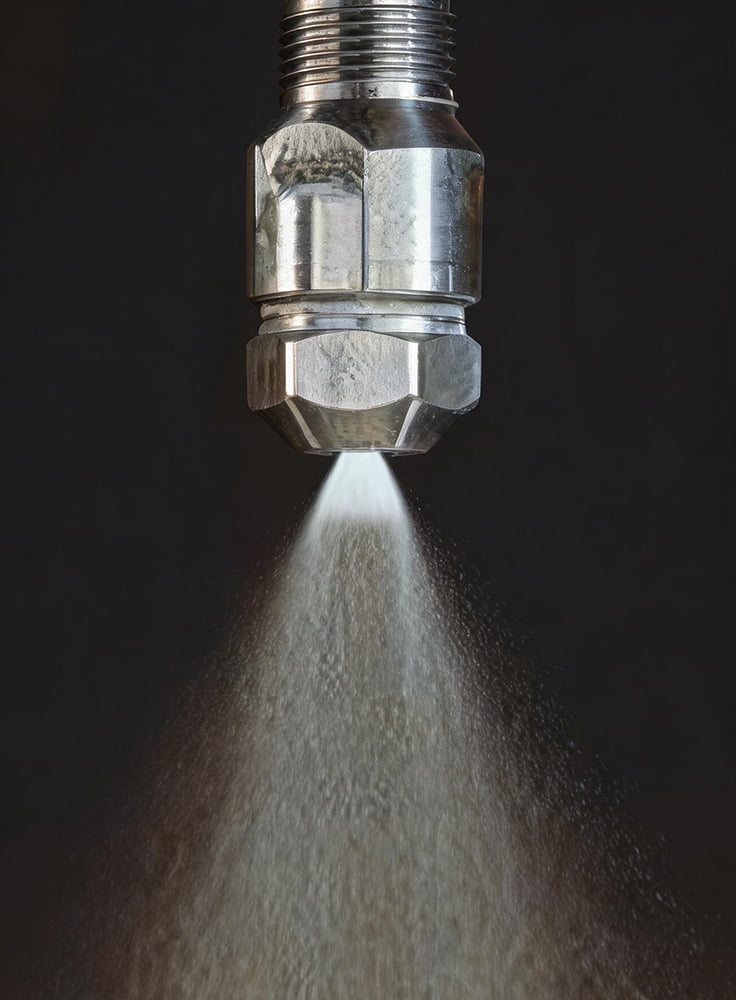
Pressure Nozzle Atomizer
Droplet Size Range
Pressure Nozzle| Pressure (MPa) | Droplet Size D50 (μm) |
|---|---|
| 1.5 - 2.0 | 150 - 350 |
| 2.5 - 5.0 | 50 - 150 |
| 5.0 - 10.0 | 30 - 50 |
| 10.0 - 20.0 | 15 - 30 |
The table above provides reference data on size ranges for low-viscosity, Newtonian fluids.
Features
Key Technical Features
Particle Morphology
Moisture evaporation leads to the formation of solid or hollow spherical particles. This microspherical morphology results in the powder excellent flowability.
Narrow Distribution
Pressure spray drying typically produces relatively large particles, generally ranging from 100 to 300 microns. More importantly, it yields a narrow particle size distribution.
Wide Feed Range
It is most suitable for homogeneous solutions or suspensions with low-to-medium viscosity and moderate solid content (typically 10%-50%).
Energy Efficiency
Pressure atomization has higher energy conversion efficiency than centrifugal spray drying, leading to lower energy use in large-scale continuous production.
Simple Structure
Without high-speed mechanical parts, the pressure nozzle has minimal wear. Maintenance is simple and convenient.
Continuous Production
Pressure spray drying is optimized for industrial scale, continuous operation. It features high automation and large capacity.
Specification
YPG Series Data Sheet
| Parameter | YPG-50 | YPG-100 | YPG-150 | YPG-200 | YPG-300 | YPG-500 | YPG-1000 |
|---|---|---|---|---|---|---|---|
|
Evap. Capacity |
50 kg/h | 100 kg/h | 150 kg/h | 200 kg/h | 300 kg/h | 500 kg/h | 1000 kg/h |
|
Chamber Diameter |
Ø1,600 mm | Ø2,000 mm | Ø2,400 mm | Ø2,800 mm | Ø3,200 mm | Ø3,800 mm | Ø4,600 mm |
|
Pump Pressure |
2-10 MPa | ||||||
|
Inlet Temp. |
140-350 °C | ||||||
|
Final Moisture |
< 5% | ||||||
|
Recovery Rate |
> 97% | ||||||
|
Heat Source |
Elec. / Steam | Elec. / Steam / Oil / Gas |
|||||
* All specifications subject to change. Contact our engineering team for custom configurations and material-specific process parameters.
Download Full Technical Datasheet
Get the complete specifications, and performance data in one document. PDF · ~2MB
Applications
Typical Drying Applications Across Multiple Industries.
Food & Additives
- Whole Milk Powder
- Instant Coffee
- Maltodextrin
- Soy Milk Powder
- Chicken Essence
Chemicals
- Laundry Powder
- Surfactants
- Dye Intermediates
- Calcium Carbonate
- Sulfates
Ceramics
- Alumina
- Zirconia
- Silicon Nitride
- Silicon Carbide
- Tungsten Carbide
Agrochemical
- Mancozeb WP
- Imidacloprid WDG
- Glyphosate WDG
- Manganese Sulfate
- Urea Phosphate
FAQ
Answers to the most common technical and commercial questions from procurement managers and process engineers evaluating pressure spray dryers.
Still have questions?
Our engineers are available for a 30-minute technical consultation.
Book a ConsultationWhat is the difference between a pressure spray dryer and a rotary atomizer spray dryer?
Briefly, the difference is in two main respects:
- Atomization – Pressure nozzle uses a high-pressure pump; rotary atomizer uses a high-speed spinning disc.
- Particles – A pressure type makes large, flowable spheres; a rotary type makes fine, uniform powder.
What is the required feed solid content for a pressure spray dryer?
Will the nozzle get clogged?
Yes. Common causes include:
- Oversized solid particles in the feed
- Insufficient filtration of the feed
- Excessively high viscosity of the feed
Does the feed material have viscosity requirements?
Why are pressure spray dryers generally so large?
The process inherently requires a large dryer volume.
- Height – Ensures sufficient drying time for droplet descent.
- Diameter – Prevents spray cone from hitting the wall, allows uniform air distribution, and accommodates large evaporation loads.
What is the lead time?
Typically 12–16 weeks, depending on design complexity and customization requirements.
Related Equipment
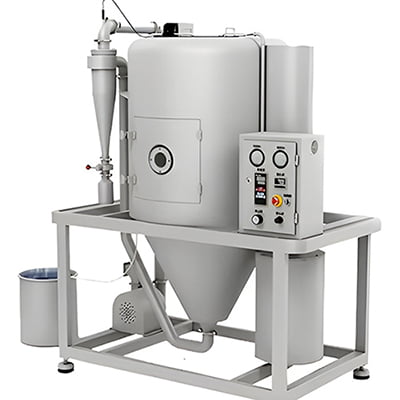
Rotary Atomizer Spray Dryer
Features a high-speed rotary atomizer for stable operation, uniform particle size, and consistent product quality.
Learn More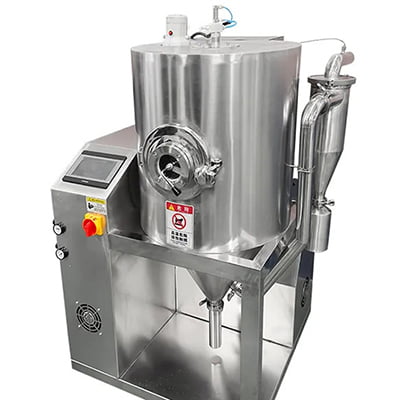
Two Fluid Nozzle Spray Dryer
Uses compressed gas and liquid feed to produce fine, uniform droplets for efficient spray drying.
Learn More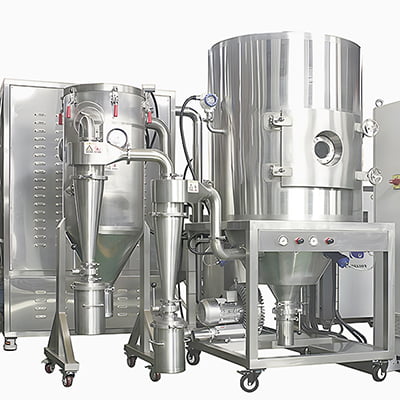
Pilot Spray Dryer
Ideal for process optimization, scale-up studies, and pilot-scale production before commercial manufacturing.
Learn More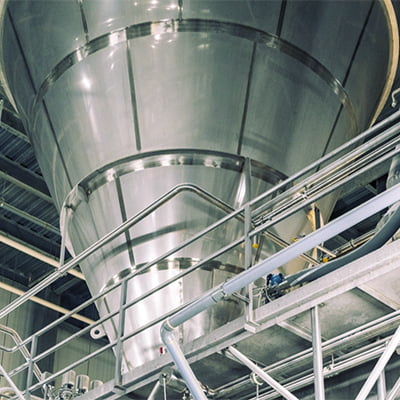
Industrial Spray Dryer
A high-capacity spray drying system designed for continuous, large-scale industrial production.
Learn More